Carbide Cutting Insert vs. CBN: What’s the Key Difference in Performance and Application?

When choosing the right insert for machining, the decision often comes down to Carbide Cutting Inserts versus CBN inserts. Both are essential in precision engineering and metalworking, but they serve very different roles. This article explains what sets them apart in terms of material, use cases, tool life, and cost—helping you choose the right insert for your operation.


🔍 What Is a Carbide Cutting Insert?

Carbide cutting inserts are made from tungsten carbide—a tough, wear-resistant material formed by combining tungsten and carbon. They are among the most commonly used cutting tools in the industry, known for their versatility across different metals and machining operations.

✅ Features of Carbide Inserts:

  • Material: Tungsten carbide with a cobalt binder

  • Hardness: High, but lower than CBN

  • Ideal for: Mild steel, aluminum, cast iron, and stainless steel

  • Use cases: Roughing, general turning, high-speed cutting

  • Coating options: TiN, TiAlN, and others for heat and wear resistance


💎 What Is a CBN Insert?

CBN (Cubic Boron Nitride) inserts are made from one of the hardest materials available—second only to diamond. Designed specifically for hard turning, CBN inserts excel when machining hardened steels and superalloys at high speeds with exceptional surface finishes.

✅ Features of CBN Inserts:

  • Material: Cubic boron nitride bonded with a ceramic or metallic binder

  • Hardness: Extremely high

  • Ideal for: Hardened steel (>45 HRC), tool steels, cast iron, superalloys

  • Use cases: Finishing, precision cutting, dry machining

  • Durabilité: Superior in high-heat, continuous cutting operations
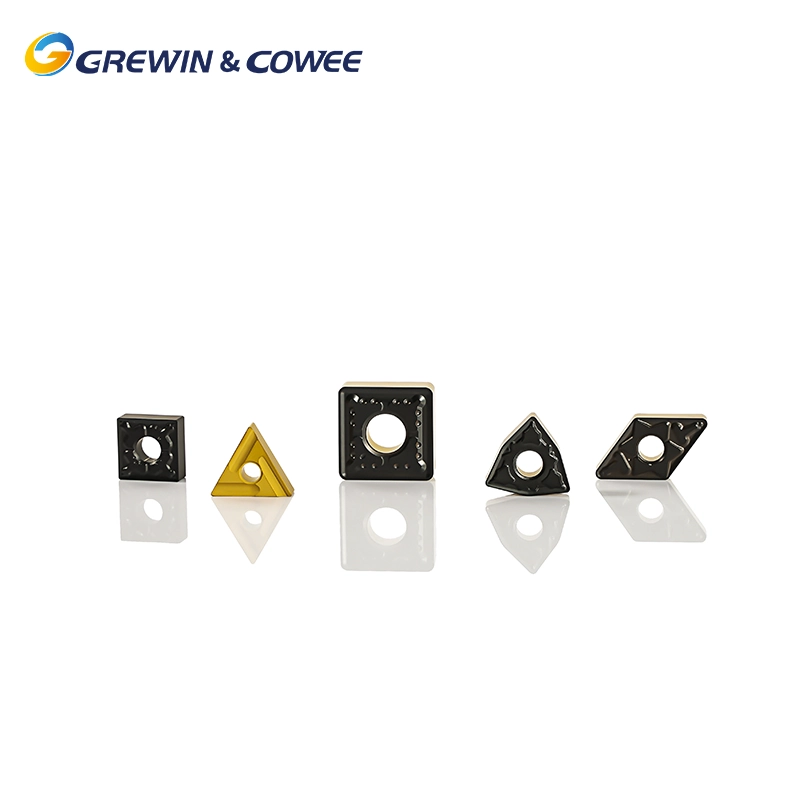
Insert de coupe en carbure

📊 Carbide Cutting Insert vs. CBN Insert – Quick Comparison

PropertyInsert de coupe en carbureCBN Insert
HardnessHighVery High (second only to diamond)
Résistance à la chaleurGoodExcellent
ToughnessBetter for interrupted cutsMore brittle, sensitive to impact
Material SuitabilitySoft to medium-hard metalsHardened steels, cast iron, superalloys
Outil de la vieModerate to long (in coated versions)Very long (in stable applications)
CostMore affordableHigher cost
Best UseGeneral machining, roughingPrecision finishing, hard turning

🔧 When to Use a Carbide Cutting Insert

Carbide inserts are your best choice when:

  • You’re machining general-purpose materials like mild steel or aluminum.

  • You need a balance of performance and cost.

  • You require frequent tool changes.

  • Your operation includes interrupted cuts or rough machining.

Carbide offers better shock resistance than CBN, making it ideal for parts with varying geometry or inconsistent hardness.


💡 When to Use a CBN Insert

CBN inserts are ideal when:

  • You’re working with hardened steels (above 45 Rockwell hardness).

  • You need consistent dimensional accuracy and fine surface finish.

  • Your priority is tool longevity over upfront cost.

  • You’re running high-speed production where insert changes slow you down.

Note: CBN works best under stable cutting conditions with minimal vibration.


🛠 Application Scenarios: Which Insert to Choose?

ApplicationBest Choice
General steel turningInsert de coupe en carbure
Finishing hardened tool steelCBN Insert
Aluminum parts machiningUncoated Carbide Insert
Intermittent cuts in cast ironTough Carbide Grade
High-precision dry hard turningCBN Insert

🧠 Key Considerations Before You Decide

Before choosing between carbide and CBN:

  • Material type: Soft metals → carbide. Hardened materials → CBN.

  • Operation type: Roughing → carbide. Finishing → CBN.

  • Cost tolerance: Budget-sensitive? Start with carbide.

  • Production volume: Long runs? Invest in CBN for lower long-term costs.


📘 Real-World Examples

▶️ Case 1: Automotive Shaft Finishing

A manufacturer working with HRC 58 shafts found that switching from carbide to CBN reduced cycle time by 35% and increased tool life by 5x.

▶️ Case 2: Mold Steel Machining

In machining P20 mold steel (~30 HRC), carbide cutting inserts outperformed CBN in cost per part due to lower insert pricing and better impact resistance.


🔄 Can You Swap Them?

In some light-duty applications, carbide can temporarily replace CBN—but not the other way around. CBN inserts are not designed for soft metals or interrupted cuts and will wear quickly or chip.

Rule of thumb: Carbide is flexible, CBN is specialized.

📌 Summary: Which Is Right for You?

NeedChoose
Budget-friendly versatilityInsert de coupe en carbure
Long-lasting performanceCBN Insert
Hard turning of HRC > 45CBN Insert
General-purpose steel machiningInsertion en carbure
Precision, finish, and speedCBN Insert

📣 Final Thoughts

Both Carbide Cutting Inserts and CBN inserts are essential tools in the machining world. Carbide offers cost-effective flexibility, while CBN provides unmatched performance in hard turning. Choosing the right insert not only improves machining efficiency—it directly impacts your bottom line.


💬 Found This Helpful? Share It!

If you learned something valuable about carbide vs. CBN inserts, share this article with your team, on LinkedIn, or in your next tooling discussion. Better tooling knowledge leads to smarter production decisions.


Would you like a version of this content formatted as a downloadable product guide or landing page content? I can help with that too!

Get Technical Data & Expert Advice:

It works best on steel, aluminum, cast iron, and stainless steel, offering versatility across most general machining tasks.

Tool life depends on material and cutting conditions, but coated carbide inserts usually offer good durability for medium to high-volume runs.

It may be due to excessive feed rates, interrupted cuts, or using the wrong insert grade for the material hardness.

No, carbide inserts are not ideal for materials above 45 HRC. For hardened steel, CBN inserts are a better choice.

Coated inserts resist heat and wear better, while uncoated ones are preferred for non-ferrous materials like aluminum.

Veuillez activer JavaScript dans votre navigateur pour remplir ce formulaire.

Laissez un commentaire

Votre adresse e-mail ne sera pas publiée. Les champs obligatoires sont indiqués avec *

Panier
fr_FRFrench
Retour en haut