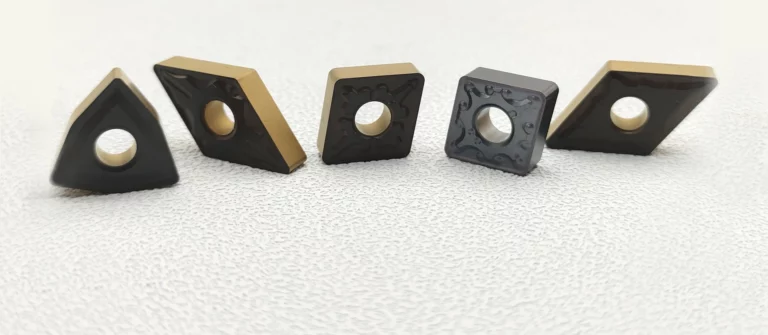
Carbide cutting inserts are essential components in modern machining, providing unmatched durability, precision, and efficiency. These small, but incredibly strong, tools have transformed industries like metalworking, automotive, and aerospace by improving productivity and the quality of finished products. This article delves into the key advantages, types, and applications of carbide cutting inserts, offering a guide for businesses and professionals looking to optimize their machining processes.
Inhaltsverzeichnis
UmschaltenWhat is a Carbide Cutting Insert?
A carbide cutting insert is a small, replaceable piece of carbide material, commonly used in turning, milling, drilling, and other machining processes. Carbide, a compound of carbon and tungsten, is renowned for its hardness and wear resistance. These inserts are designed to fit into a tool holder, offering a cost-effective solution compared to traditional solid tools.
Unlike solid carbide tools, inserts can be replaced individually when they wear out, saving both time and money. The ability to quickly swap out inserts without replacing the entire tool allows for greater operational flexibility and improved overall efficiency.
Why Choose Carbide Cutting Inserts?
Here are several reasons why carbide cutting inserts are a preferred choice in machining:
Durability and Wear Resistance
Carbide is much harder than steel, making it an excellent choice for high-speed cutting. It resists wear and retains its sharpness longer than other materials, which reduces downtime and lowers tool replacement costs.Kosteneffizient
Since only the insert is replaced and not the entire tool, carbide inserts can significantly reduce tool costs in the long run. Their longer lifespan means fewer replacements, leading to less frequent maintenance.Verbesserte Oberflächenbeschaffenheit
Carbide cutting inserts provide a smooth, high-quality finish on workpieces, making them ideal for precision parts that require a clean, polished surface.Increased Cutting Speed
Carbide inserts can handle higher cutting speeds and feed rates, improving productivity in high-volume manufacturing settings. The efficiency gained in production can often outweigh the initial investment.Vielseitigkeit
Available in various shapes and coatings, carbide cutting inserts are adaptable for different machining applications, including turning, milling, and threading, allowing manufacturers to use the same material across a wide range of tasks.
Types of Carbide Cutting Inserts
Carbide cutting inserts come in a variety of shapes and designs to accommodate specific machining tasks. Here are the most common types:
Triangle Inserts
These are versatile inserts used in turning and milling operations. Their three-sided shape ensures that even if one cutting edge wears out, the insert can be rotated to use another side.Square Inserts
Square inserts are ideal for general-purpose milling and turning. Their geometry provides excellent stability and precision, making them highly effective in a variety of materials.Round Inserts
These inserts are typically used for finishing applications, where a smooth, high-quality surface is required. Their rounded edges provide excellent surface integrity.Octagon Inserts
With eight edges to work with, octagon inserts offer great value for money. They are often used in heavy-duty machining tasks, providing an extended tool life due to the multiple edges.Special Inserts
For unique machining tasks, such as complex or highly specialized applications, custom inserts are designed. These might include coatings for specific materials or geometries for intricate parts.
How to Choose the Right Carbide Cutting Insert?
Selecting the correct carbide cutting insert can be critical to achieving optimal performance. Consider these factors when making your choice:
Material to be Machined
Different materials—such as steel, aluminum, or titanium—require different types of inserts. Carbide inserts come with varying coatings that help enhance performance on specific materials, such as coatings for heat resistance or wear resistance.Cutting Speed and Feed Rate
If your machining process requires high speeds or aggressive feeds, a tougher, more durable carbide insert will be necessary to withstand the increased stress.Insert Shape and Geometry
The shape of the insert affects its ability to perform specific tasks. For example, a round insert is better suited for finishing, while a triangular insert may be better for roughing operations.Beschichtungsmöglichkeiten
Carbide inserts are often coated with materials like titanium nitride (TiN) or titanium carbide (TiC) to improve hardness, reduce wear, and extend tool life. Selecting the right coating can significantly enhance the performance of the insert.

Applications of Carbide Cutting Inserts
Carbide cutting inserts are widely used in several industries, including:
Automobilbau
These inserts are crucial in producing engine parts, transmission components, and other high-precision parts for the automotive industry.Aerospace
In aerospace, where precision and reliability are paramount, carbide inserts are used to machine tough materials like titanium and high-strength alloys.Metallbearbeitung
Whether it’s for turning, milling, or drilling, carbide inserts are used in a wide range of metalworking applications to achieve clean, precise cuts.Tool and Die Making
Carbide inserts are essential in producing molds and dies that are used to shape and form metals in mass production.
Get Technical Data & Expert Advice:
- Download specs & technical guides: www.grewintools.com or www.gwcarbide.com
- For Russian customers: www.grewintools.ru
- Connect directly for samples or consultation:
- Contact: Lydia Choo
- WhatsApp: +86-18673327292
- Email: info@gwcarbide.com
- Additional product lines: www.coweecarbide.com
The lifespan of carbide inserts depends on the cutting conditions and the material being machined. Typically, carbide inserts can last anywhere from several hours to hundreds of hours, depending on how frequently they are used and the nature of the work.
Carbide inserts are highly effective for a wide range of materials, including steel, cast iron, aluminum, and titanium. However, choosing the right insert and coating for specific materials is key to achieving optimal results.
Signs that an insert needs replacement include visible wear on the cutting edge, reduced cutting performance, or a decrease in surface quality of the finished product. Regular monitoring of the insert’s condition is recommended.
Yes, carbide inserts are ideal for high-speed machining due to their ability to withstand heat and maintain sharpness at higher speeds.
While carbide inserts can sometimes be re-sharpened, it is usually more cost-effective and time-efficient to replace them once they are worn down, especially in high-volume applications.