
When it comes to machining titanium, the tools you choose can make all the difference. One of the most crucial tools in this process is the end mill. Understanding how to select the best end mills for titanium is essential for achieving precise results and maximizing tool life. In this article, we will explore the significant factors to consider when choosing end mills for titanium and elaborate on the benefits and application areas that make these tools indispensable.
Understanding Titanium and Its Challenges
Titanium is known for its high strength-to-weight ratio and excellent corrosion resistance. However, machining titanium presents unique challenges due to its toughness and tendency to work-harden. Traditional cutting tools may struggle with these properties, leading to increased tool wear and decreased productivity.
For instance, consider a manufacturer who is tasked with creating aerospace components made from titanium. If they use standard end mills, they might discover that the tools dull too quickly, resulting in longer lead times and higher production costs. Selecting the right end mills for titanium helps mitigate these challenges, improving efficiency and reducing wear.
Material and Coating
When selecting end mills for titanium, the material of the cutting tool plays a significant role. Carbide end mills are often preferred due to their hardness and resistance to deformation. They can withstand the high temperatures generated during titanium machining, ensuring a longer lifespan.
Additionally, the coating of the end mill can enhance its performance. For instance, end mills coated with titanium nitride (TiN) or titanium carbonitride (TiCN) can reduce friction and improve surface finish. These coatings allow the tool to dissipate heat more effectively, making them ideal for machining titanium. Choosing a coated carbide end mill can lead to significant savings in both tool replacement costs and downtime.
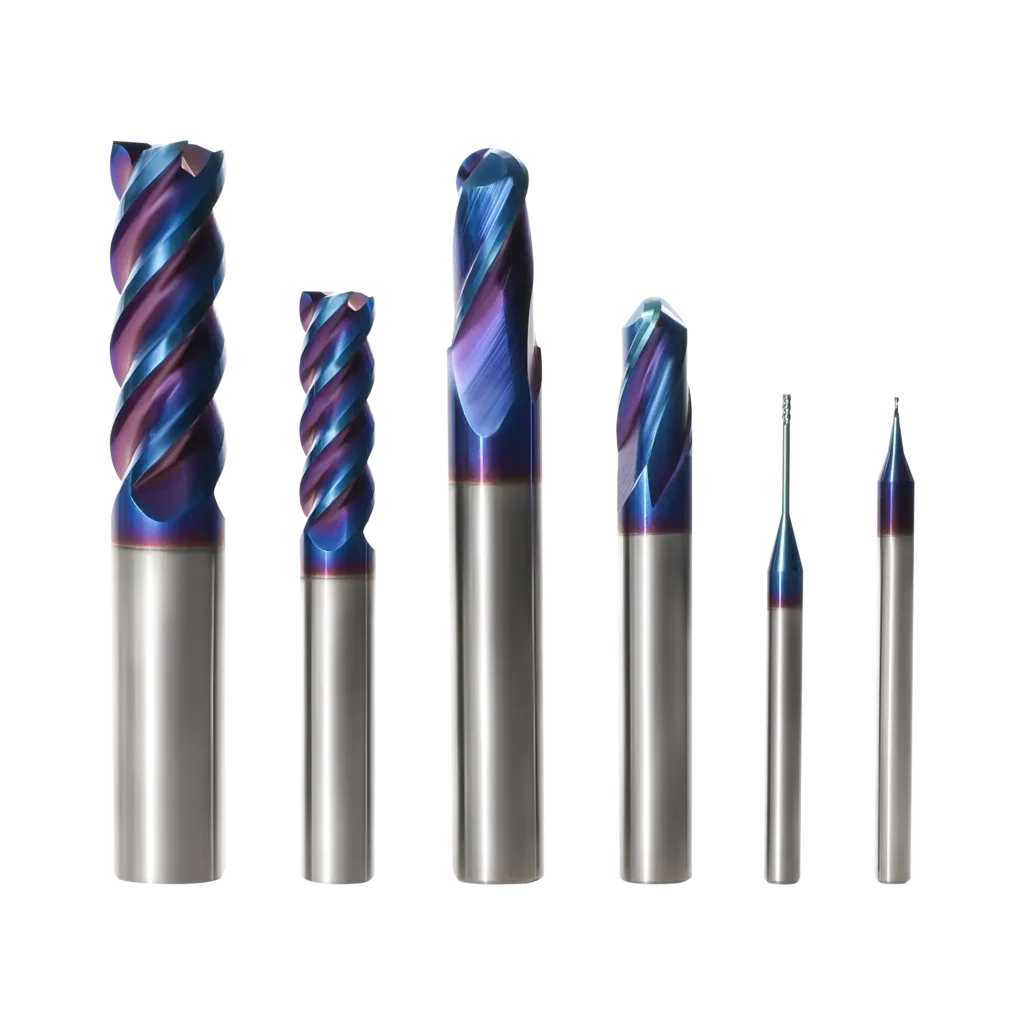
Geometry and Design Considerations
Understanding the geometry of end mills is also crucial for effective titanium machining. The number of flutes, helix angle, and cutting edge design can all impact performance. For example:
1.Flute Count: End mills for titanium often have a reduced number of flutes (e.g., two or three). A lower flute count allows for better chip evacuation, which is vital when working with such a dense material. This prevents clogging and overheating, leading to more efficient machining.
2.Helix Angle: A higher helix angle can improve cutting performance and help generate a better finish on titanium. However, a lower angle might be beneficial for specific operations, such as heavy roughing, where more stability is required.
3.Cutting Edge Design: Some end mills are designed with sharp cutting edges to enhance cutting efficiency. Others may feature rounded edges to improve tool life and surface finish. It’s important to match the edge design with the specific type of machining operation being performed.
As an example, a company specializing in defense components may select a two-flute, high-helix end mill for achieving a smooth surface finish in finishing operations. In contrast, a business working on heavy components might prefer a three-flute end mill for increased cutting stability during roughing.
Workholding and Machining Parameters
Selecting end mills for titanium doesn’t stop at the tool itself. Workholding setups, machining parameters, and cutting strategies are equally important. Using effective workholding methods can greatly impact precision and stability. For instance, using vises designed for rigidity can ensure that the titanium workpiece remains in place throughout the machining process.
Furthermore, proper machining parameters—such as spindle speed, feed rate, and depth of cut—must be considered. Decreasing the speed while increasing the feed rate can often yield optimal results when machining titanium. For example, a machinist might find that running the end mill at a slightly slower speed allows the tool to cut without excessive wear.
Applications of End Mills for Titanium
End mills for titanium are utilized across a variety of industries, each with its own unique requirements and standards. Some key application areas include:
1.Aerospace: The aerospace industry frequently uses titanium for structural components due to its lightweight and strong properties. Precision end mills are essential for creating intricate designs needed in aircraft frames and engine parts.
2.Medical: Titanium is biocompatible, making it ideal for medical implants. End mills designed for titanium are critical in manufacturing precision medical devices, ensuring high reliability and patient safety.
3.Automotive: The demand for lightweight and durable materials in the automotive industry has led to the increased use of titanium. End mills play a vital role in machining components like connecting rods and exhaust valves.
By considering these applications, manufacturers can select end mills that not only meet technical specifications but also meet the regulatory standards required in their respective fields.
Wniosek
In conclusion, the selection of the best end mills for titanium machining is a detailed process that involves various factors, including material, coating, geometry, and application. Understanding these elements enables manufacturers to enhance productivity, reduce costs, and improve the quality of their finished products. By investing time in selecting the right end mills for titanium, businesses can navigate the challenges of machining this demanding material more effectively and reap the benefits of durability and efficiency.
Ultimately, the right choice of end mills for titanium can lead to innovative designs and advancements in technology across multiple industries, making it a decision with far-reaching consequences.
Get Technical Data & Expert Advice:
- Download specs & technical guides: www.grewintools.com or www.gwcarbide.com
- For Russian customers: www.grewintools.ru
- Connect directly for samples or consultation:
- Contact: Lydia Choo
- WhatsApp: +86-18673327292
- Email: info@gwcarbide.com
- Additional product lines: www.coweecarbide.com
 Polish
  English
  Chinese
  German
  French
  Portuguese
  Spanish
  Turkish
  Russian